Every drone has a published maximum wind speed rating. Most commercial UAS operators know their aircraft’s number. What the spec sheet doesn’t tell you is how gusts behave near a tower structure, or why a 20-mph gust at a mapping site and a 20-mph gust at a 200-foot tower are not the same operational problem.
Understanding the difference is one of those things that separates pilots who’ve done tower inspection work from pilots who are planning to.
Why Tower Inspection Is Different
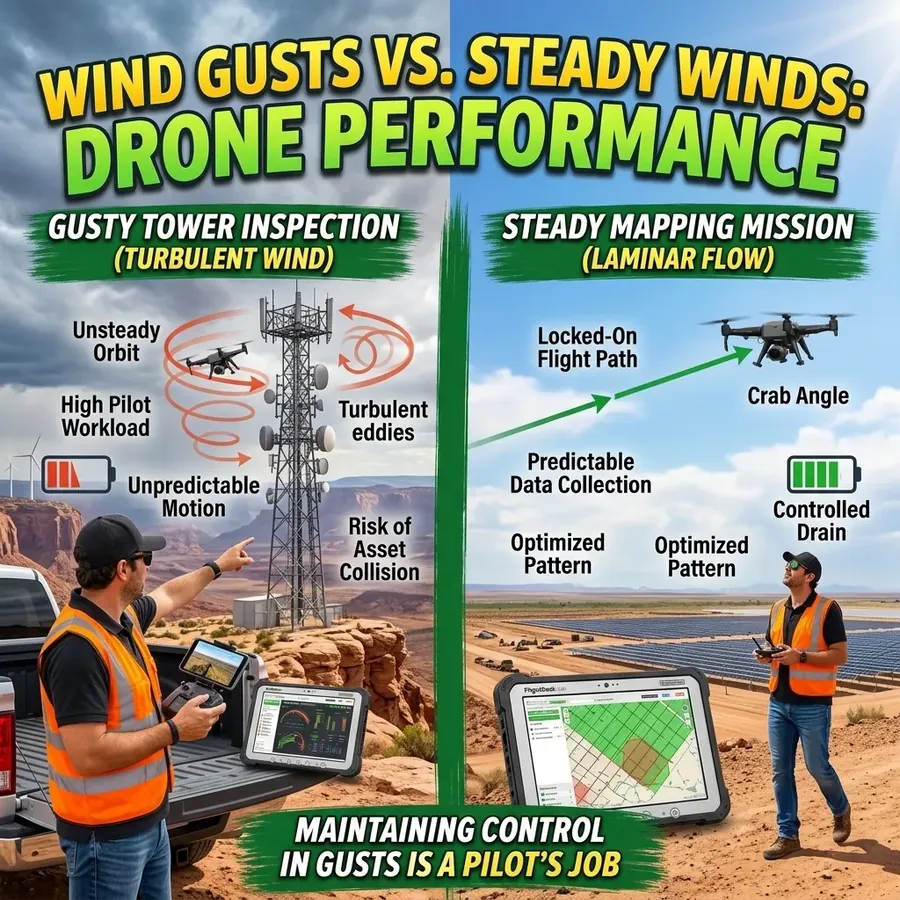
A mapping mission is typically conducted at altitude, in open air, away from significant vertical obstructions. Wind is a factor — it affects image overlap, ground speed, and flight efficiency — but the drone is operating in relatively undisturbed airflow.
Tower inspection is different in almost every respect. You’re flying within feet of a large vertical structure at varying altitudes, often in a tight orbit. The structure itself disturbs the airflow. Wind that hits the tower face creates turbulence on the lee side, vortices off the edges, and unpredictable pressure gradients around antennas, platforms, and equipment clusters. A steady 18-mph wind becomes a 25-mph gust on the downwind side of the tower, then a sharp direction change as you round the corner.
The drone’s flight controller compensates for this continuously, but compensation has limits. The closer you are to the structure, the faster a loss of position control becomes a collision.
The Gust Problem Specifically
Steady wind is manageable. Gusts are the real variable. A gust is a rapid, brief increase in wind speed above the sustained baseline — and its effect on a drone depends on where the aircraft is in its orbit when the gust arrives.
On a mapping mission, a gust pushes the drone off its planned line and the flight controller corrects. The consequence is a minor deviation in coverage or an image taken a fraction of a second late. On a tower inspection mission, the same gust arriving when the drone is three feet from the antenna face has a different consequence.
The practical implication: your go/no-go wind threshold for tower inspection work should be more conservative than for mapping work, and it should be driven by the gust speed as much as the sustained speed. A 12-mph sustained wind with gusts to 22 mph is a different risk profile than 12 mph sustained with gusts to 14 mph — and the sustained number is the one that appears in weather apps.
FlightDeck records both sustained wind speed and gust speed for every remaining site during the weather update. Looking at the gust column before planning the next day’s tower work gives you the picture that the sustained-only forecast misses.
Structural Geometry Matters
Lattice towers — the classic steel framework structures — are more turbulent than monopoles. The open geometry creates complex vortex shedding patterns as wind passes through the structure. Monopoles and guyed towers with solid or semi-solid profiles shed wind differently. Rooftop installations add the building’s own wake and channeling effects.
There’s no single threshold that applies across all structure types. The best calibration comes from time on different structures in varying conditions — building an experiential sense of how each geometry behaves before pushing to the structural limits of the operation.
When to Call It
The honest answer on wind limits for tower inspection is that the published aircraft rating is a maximum, not a target. Most experienced tower inspection pilots operate with an effective personal limit considerably below the aircraft maximum, and they set that limit based on gust speed, not sustained speed.
If conditions are at or above your personal limit, the right call is usually to push the site rather than push through. A re-fly is inconvenient. A collision with the structure or a loss of control event is something else entirely.
The weather data in FlightDeck gives you the wind and gust picture at each site before you make the drive. That’s the decision point where conservative judgment costs you an hour of planning and saves you a great deal more.