July 4, 2026 isn’t just Independence Day — it’s the 250th anniversary of the United States. The Semiquincentennial. Every major city, countless small towns, and millions of people will be outside, looking up, celebrating with fireworks displays, parades, and public gatherings unlike anything seen in recent memory.
For commercial and recreational drone pilots, this creates one of the most complex and restricted flying environments of the entire year. Here’s everything you need to know before you even think about launching on or around July 4th.
TFRs Will Be Everywhere — and They’ll Change Right Up Until Launch
Temporary Flight Restrictions around fireworks displays and major public gatherings are standard FAA practice on July 4th. In a typical year, TFRs cover dozens of major display sites. For the 250th, expect significantly broader coverage, including:
- Pyrotechnic TFRs extending to 3 nautical miles radius and 3,000 ft AGL around major displays
- Security TFRs around presidential and governmental events that may cover entire metro areas
- Stadium and venue TFRs for large organized celebrations
- Temporary no-drone zones in high-traffic public areas issued by local authorities
The critical issue: TFRs for July 4th events are often not published until a day or two beforehand, and they frequently update or expand right up to the event. A site that was clear when you checked Monday may have a TFR by Wednesday afternoon.
This is exactly why FlightDeck’s live TFR checking tool matters. It monitors every site in your project queue against active TFRs in real time and alerts you when a TFR overlaps any of your planned sites — including new TFRs issued after your last manual check.
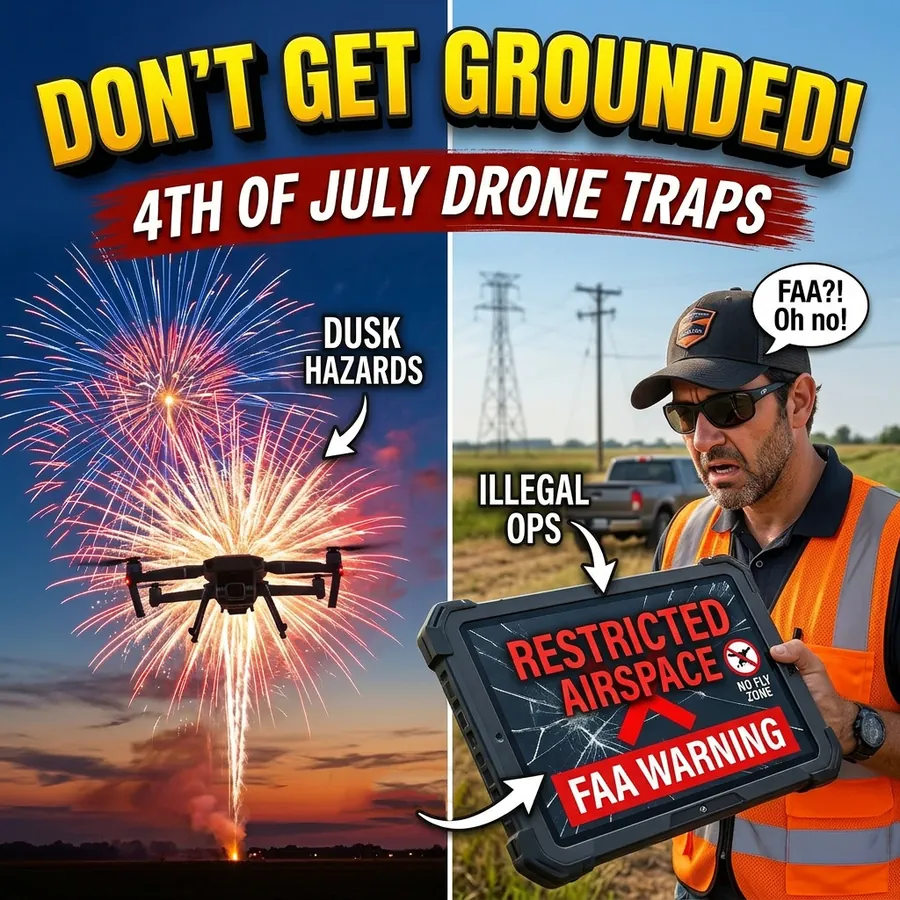
Dusk Operations: The Light You’re Planning For Isn’t the Light You’ll Have
Most photographers and videographers want to fly at dusk on July 4th — the golden hour before dark, catching fireworks launches against a deepening sky. This creates specific operational challenges that are different from either daytime or full night operations.
Civil twilight vs. legal night. Under Part 107, night operations require either a waiver (under older rules) or compliance with the anti-collision lighting requirements that took effect after the 2021 rule update. Civil twilight — the period from sunset until 30 minutes after — is defined as the beginning of night for Part 107 purposes. You need to know exactly when civil twilight begins at your specific location and plan accordingly.
Visual acuity degrades faster than you expect. Your eyes adapt slowly to changing light. At dusk, the transition from “I can see fine” to “I can’t clearly determine orientation” happens faster than pilots anticipate. Know your aircraft’s lighting configuration and whether it meets the 3-statute-mile visibility requirement for night ops before the light drops.
Battery performance at night. Summer evenings can be warm, which helps battery performance, but if temperatures drop after sunset, expect reduced flight times. Plan conservative battery margins for dusk operations where a landing in reduced visibility takes longer to execute safely.
Crowd Density and the Operations Over People Rules
July 4th gatherings involve dense crowds — exactly the scenario that Part 107’s operations over people rules are designed to address. Unless you have the specific approvals for Category 2, 3, or 4 operations over people with appropriate aircraft certification, flying over or directly above crowds is prohibited.
For commercial operators with a legitimate mission adjacent to a 4th of July event, the crowd consideration requires careful site planning. Know where the crowd is, know its boundary, and maintain your operational footprint clear of it. Have an abort plan that accounts for crowd movement if people shift toward your operating area.
Local Restrictions Beyond Part 107
Many jurisdictions have local drone ordinances that add restrictions beyond federal rules, and local authorities often issue special event restrictions for major public gatherings. These may not appear in FAA systems. Check your local city and county regulations, and if flying near any permitted event, verify directly with the event organizer and local authority whether drone operations are permitted.
The 250th Anniversary Commercial Opportunity
For commercial UAS pilots with the right authorizations and a professional operation, the 250th anniversary is a genuine content opportunity. Municipal clients, media companies, event organizers, and tourism boards are commissioning aerial coverage of Semiquincentennial events nationwide. If you want to pursue this work, the time to get your authorizations, permits, and client agreements in place is now — not July 2nd.
FlightDeck’s Airspace Checker analyzes your specific site against the full FAA airspace database, identifies LAANC eligibility, and generates the authorization path documentation you need to support a client engagement or permit application. The Compliance Manager generates COA narrative content for controlled airspace operations that can’t use LAANC.
Download the free 30-day trial and have your airspace analysis and TFR monitoring running before July 1st. The 250th is a once-in-a-lifetime event — be the operator who was prepared for it.