The ability to fly a drone over people is one of the most commercially valuable — and most frequently misunderstood — capabilities in the Part 107 rulebook. Events, real estate, construction sites, public spaces, urban environments: a significant portion of high-value commercial UAS work involves operating in proximity to people. The rules that govern this are specific, tiered, and carry meaningful compliance consequences when they’re violated.
Here’s the complete practical guide to Part 107 operations over people.
The Four-Category Framework
The FAA established a four-category framework for operations over people based on the risk posed by the aircraft. The categories are defined primarily by aircraft weight, kinetic energy on impact, and the presence of exposed rotating parts. Each category has distinct requirements for the aircraft, the pilot, and the operation.
Category 1 — Lowest Risk
Aircraft requirement: 0.55 pounds (250 grams) or less. No exposed rotating parts that could lacerate human skin.
Pilot requirement: Standard Part 107 certification. No additional approval needed.
Operations: May operate over people, but not over moving vehicles or open-air assemblies.
The practical reality: very few commercial platforms that carry useful payloads weigh 250 grams or less. Category 1 primarily applies to micro drones. Most commercial inspection, mapping, and media production platforms are significantly heavier.
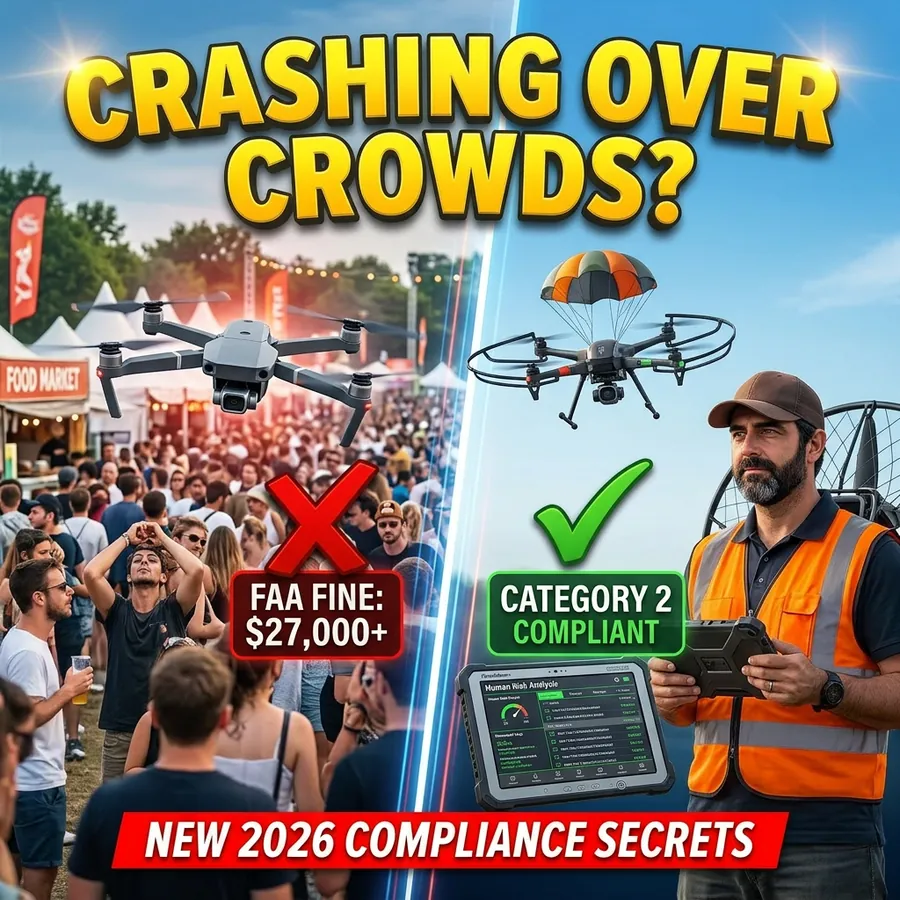
Category 2 — Moderate Risk
Aircraft requirement: Must meet FAA-accepted means of compliance demonstrating that impact with a human would not cause injury at or above the threshold of serious injury. No exposed rotating parts that could lacerate. Aircraft must carry an FAA-accepted declaration of compliance (DoC).
Pilot requirement: Standard Part 107 certification.
Operations: May operate over people and moving vehicles. May operate over open-air assemblies.
The DoC requirement is critical: the manufacturer must have filed an FAA-accepted declaration of compliance, and the aircraft must be identified on the FAA’s accepted DoC list. You cannot self-certify your aircraft as Category 2. Check the FAA website for the current accepted DoC list.
Category 3 — Higher Risk, Restricted
Aircraft requirement: Same DoC requirement as Category 2. The kinetic energy threshold is higher, but the operational restrictions are correspondingly tighter.
Pilot requirement: Standard Part 107 certification.
Operations: May operate over people only within a restricted-access site where all people in the area are on notice that a drone may fly over them. May NOT operate over open-air assemblies.
The restricted-access and notice requirements for Category 3 make it most applicable to controlled work environments: secured construction sites, private property operations with a controlled perimeter, and similar scenarios where the operator can ensure bystander notification.
Category 4 — Airworthiness Certificate
Aircraft requirement: Must hold an FAA airworthiness certificate (like a manned aircraft). This is a significant certification undertaking.
Pilot requirement: Standard Part 107 certification.
Operations: Must comply with the operating limitations specified in the aircraft’s FAA-approved flight manual. May operate over people and moving vehicles if the flight manual permits it.
Category 4 is currently relevant to a small number of highly specialized UAS platforms and is not a practical path for most commercial operators.
What “Open-Air Assembly” Means
The FAA defines an open-air assembly as a gathering of people that is open to the public. Concerts, sporting events, street fairs, parades — these are open-air assemblies. Only Category 2 aircraft (with accepted DoC) may operate over them. This is one of the most important practical limits for event photography pilots to understand.
What You Cannot Do Under Any Category
- Operate over moving vehicles on public roads (unless the aircraft meets Category 2 or higher requirements and the specific operation permits it)
- Operate over a person not involved in the operation unless you meet the category requirements for that scenario
- Override weight or DoC requirements by assessing the risk yourself — the categories are the framework, not a suggestion
Documentation and Pre-Flight Planning
For operations involving people, documentation of your aircraft’s category compliance — the DoC reference, the aircraft serial number, and a record of the operation type — belongs in your mission record. If an incident occurs involving a person, your compliance documentation is the first thing the FAA will review.
FlightDeck’s structured mission logging captures the full pre-flight record including aircraft configuration, site conditions, and operational notes. Building the habit of logging operations-over-people compliance details into every relevant mission record is the mark of a professional operation.
Download the free 30-day trial and maintain the operational record that demonstrates your compliance — mission by mission, site by site.