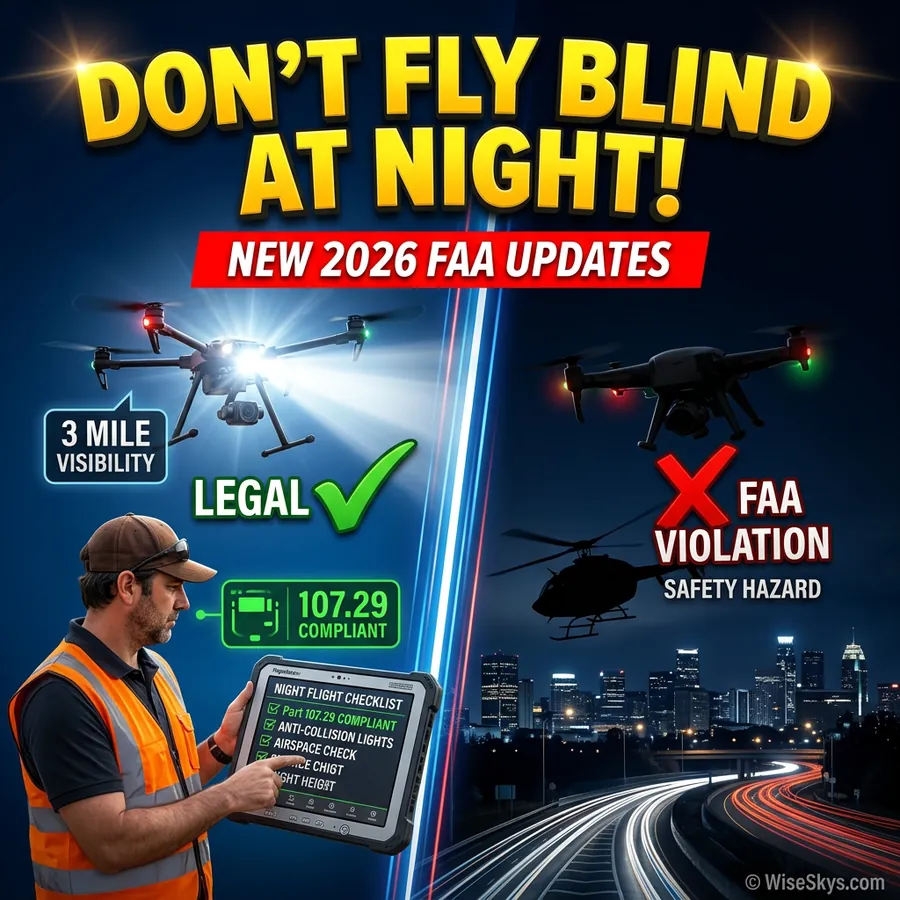
Night UAS operations under Part 107 changed significantly with the FAA’s 2021 regulatory update. What previously required a specific waiver is now permitted for certificated Part 107 pilots — but with requirements that many pilots still don’t fully understand or consistently meet. Flying at night without complying with those requirements isn’t just a legal risk; it’s a genuine safety risk in an environment where your visual reference margin is already reduced.
Here’s the complete practical guide to night UAS operations under Part 107.
What Changed in 2021
Prior to the 2021 rule update, night operations required a Part 107 waiver — a lengthy application process with no guarantee of approval. The update removed the waiver requirement for night operations, replacing it with a mandatory equipment requirement and recurrent training obligation.
Night operations are now permitted for Part 107 pilots who:
- Have completed the updated recurrent knowledge test (which covers night operations content)
- Have an aircraft equipped with anti-collision lighting visible for at least 3 statute miles
- Comply with all other applicable Part 107 requirements including airspace authorization
When Does “Night” Begin?
Under Part 107, night is defined as the period between the end of evening civil twilight and the beginning of morning civil twilight. Civil twilight ends 30 minutes after official sunset at your location. This is not the same as full dark — it’s when the sun is 6 degrees below the horizon and ambient light has dropped to a defined threshold.
This matters because civil twilight varies by location and date. On a summer evening in Alaska, civil twilight ends very late. In December in the southern states, it ends earlier. Always calculate civil twilight for your specific location and date, not a general approximation.
Anti-Collision Lighting Requirements
The anti-collision lighting requirement is specific: the light must be visible for at least 3 statute miles. This is a distance requirement, not a brightness specification. The practical implication is that not all factory-installed lighting on consumer and prosumer drones meets this threshold — particularly older platforms designed before the rule change.
Verify that your specific aircraft’s lighting configuration meets the 3-mile visibility standard. If it doesn’t, aftermarket anti-collision lighting solutions are available for most platforms. This is not optional — operating at night without compliant lighting is a violation regardless of how visible you think the aircraft is.
The lighting must also function properly. Pre-flight verification of anti-collision light operation should be part of your night operations checklist, not assumed.
Airspace Authorization Still Required
Night operations do not change airspace requirements. If your planned operation is in controlled airspace, you still need LAANC authorization or a COA. Many pilots conflate the waiver removal with a general relaxation of night rules — it isn’t. Airspace authorization is independent of the time-of-day operating rules.
Practical Night Operations Safety
Site survey during daylight. Always survey your operating area before the light drops. Hazards visible in daylight — wires, antennas, trees — may be invisible at night even with good ambient lighting. Know your environment before you need to navigate it in reduced visibility.
Fly conservatively at reduced speed. Your reaction time to emerging hazards is reduced at night. Obstacle avoidance systems on many platforms are camera-based and perform poorly or are disabled in low light. Fly slower, with wider margins, than you would in daylight.
Orientation awareness. Maintaining visual orientation of an aircraft at night is cognitively more demanding than in daylight. Know your aircraft’s lighting orientation — which lights are on the front, which are on the rear — so you can read attitude and heading from the lights alone. Practice this in a controlled environment before a client job.
Battery temperature. Cooler night air affects LiPo performance, particularly in late summer and fall when temperatures drop significantly after sunset. Use fresh, warm batteries and plan for reduced flight times compared to your daytime performance baseline.
Ground lighting. Mark your launch and landing zone with ground lighting visible from operating altitude. This gives you a positional reference and makes safe landing execution faster and more reliable in the dark.
Logging Night Operations
Night operations should be logged distinctly in your flight records — noting civil twilight time, lighting configuration confirmed, and any conditions specific to the night environment. This documentation supports your operational history for waiver applications (if you pursue BVLOS or other advanced operations) and demonstrates professionalism to enterprise clients who review your safety records.
FlightDeck captures the full pre-flight and post-flight record for every mission, with fields for conditions, notes, and authorization status — building the structured night operations log that matters when clients ask about your experience.
Download the free 30-day trial and start logging your night operations with the same professional standard you apply to every other mission in your portfolio.