
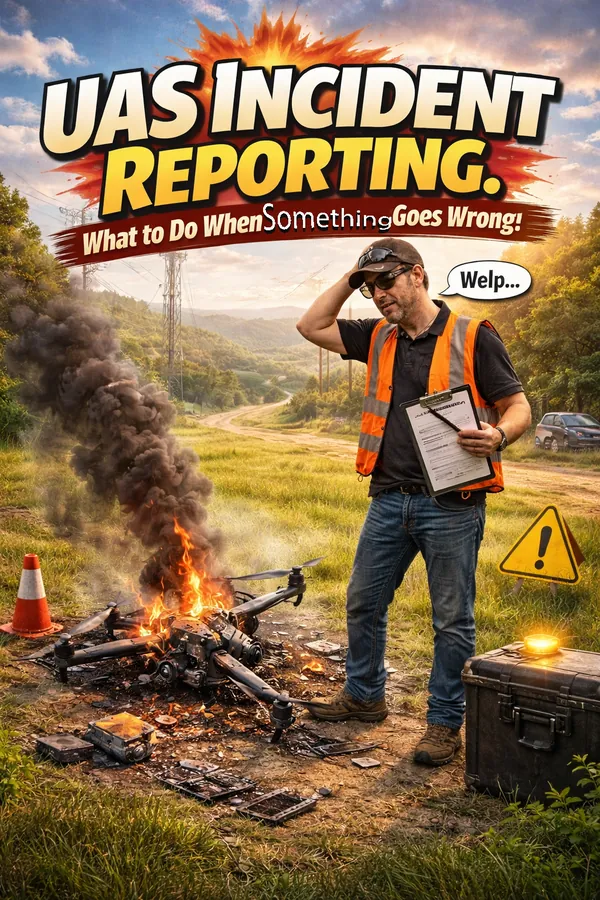
No commercial UAS pilot plans for an incident. But the ones who’ve thought through exactly what to do before one happens are the ones who handle them professionally when they occur — protecting themselves legally, maintaining client confidence, and contributing to the industry’s safety record.
Here’s what you need to know about UAS incident reporting as a commercial Part 107 operator.
What Triggers a Reporting Requirement
Under 49 CFR §830, the NTSB requires notification when a UAS operation results in:
- Serious injury to any person (hospitalization required)
- Loss of consciousness of any person
- Property damage exceeding $500 (to property other than the aircraft itself)
Additionally, the FAA can request information and records from certificate holders at any time. Under Part 107, you’re required to make your aircraft available for inspection and to cooperate with FAA investigations.
Many incidents that don’t trigger mandatory NTSB reporting are still worth documenting formally — airspace deviations, close calls with manned aircraft, equipment malfunctions, or any operation that didn’t go as planned.
Immediate Response: The First 60 Minutes
Secure the scene. If the aircraft is down in a manner that poses ongoing risk — near people, traffic, or energized lines — manage that hazard first before doing anything else.
Document everything before it changes. Photograph the aircraft position, any damaged property, the launch and landing zone, and your equipment setup. Video the scene. Note the time, GPS coordinates, weather conditions, and who was present. Do this before anything is moved or removed.
Preserve flight data. Don’t clear logs. Don’t reset the aircraft. The flight controller log, video footage, and any telemetry data may be relevant to the investigation. Preserve it.
Notify your insurer. Most commercial UAS policies require prompt notification of potential claims. Don’t wait to see if a claim materializes — notify early.
Do not make admissions. Speak factually about what happened. Don’t speculate about cause or accept liability before facts are established. This applies in conversation with clients, bystanders, and especially with any responding authority.
NTSB Reporting Process
If the incident meets the reporting threshold, notify the NTSB as soon as practicable and no later than two days after the accident. Notification can be made through the NTSB’s online reporting form or by phone. A full written report may be required within 10 days.
Keep a copy of everything submitted. If the FAA opens a parallel investigation, your documentation and the timeline of your actions matter.
The Professional Response to Non-Reportable Incidents
For incidents that don’t trigger mandatory reporting — a hard landing, a minor equipment malfunction, an airspace confusion — the professional response is still documentation and analysis.
Write an internal incident report: what happened, what the chain of events was, what the contributing factors were, and what procedural or equipment changes you’re making in response. File it. Reference it in future planning.
Pilots who document and learn from their close calls have far fewer of them over time. The ones who don’t tend to repeat the same errors until one of them becomes a reportable event.
Maintaining the Record
Your operational history — the complete record of flights, conditions, authorizations, and incidents — is your professional evidence file. FlightDeck’s SQL-backed flight logging captures 87+ data points per mission in a local database that’s always there when you need it.
When an insurer, a client, or the FAA asks what happened and when, you pull a report. You don’t reconstruct from memory.
Download the free 30-day trial and start building the operational record that protects you when something doesn’t go according to plan.